
By Sophia Pomponio, KCR contributor
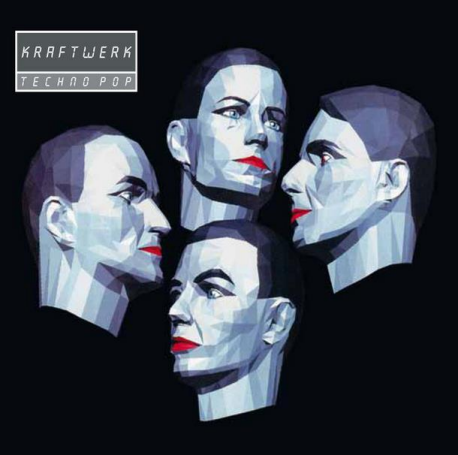
Techno Pop is the 9th Kraftwerk studio album. Originally released on October 27, 1986 as Electric Cafe, it was remastered and released under its working title, Techno Pop, on the 2nd of October, 2009. I think this is a much more fitting title. When the album had first been renamed Electric Cafe, Marketing had the sleeves ordered before the change was officially decided on. If this didn’t happen, it more than likely would’ve been released as Techno Pop. The album was actually delayed due to the band’s lead singer, Ralf Hütter, suffering a cycling accident. Though it received mixed reviews by critics, I think it is lovely and it has become my favorite Kraftwerk album so far.
Boing Boom Tschak – A very apt name, seeing as the song opens with the robotic voice making these exact utterances. I enjoy the vocals beginning with its acapella-esque beat and I am particularly fond of the sigh-like sound they include. Once the synths enter, the stark contrast between gruff electronic vocals and crystalline chiming introduces the sounds that will continue throughout the album. The main vocals in the song are “music nonstop, techno pop” which evokes to me the image of a robot running a radio show — very amusing. Overall an effective lead into the sound of the album and while it is catchy, there’s nothing particularly striking to me. 6.5/10.
Techno Pop – Leading in with minimal percussion and robotic vocals, it immediately expands on the sound set up by the opening track. Once the synths slam in, around 36 seconds, the track gets a lot more groovy. This is the first song on the album with Ralf Hütter’s vocals, adding another layer to the song. I absolutely adore the marimba on this track and they even include this organ-adjacent sound which is utterly delightful! I love how this song layers upon itself so that each time a section repeats, something new is added to it. It’s worth noting I also love their little digital triangle/cowbell song. Ralf then starts speaking Spanish and it’s great. The lyrics change to: “The music ideas will carry, and it will always carry on. Electronic sound, synthetic decibel.” I enjoy the reverb that’s added here and there and the robot even starts speaking in Spanish! It’s great! Around 5:43, even more synths get layered, making some really beauteous sounds, swapping every two repeats of the pattern or so. There’s two lines of German at the end meaning “It will always continue, music as a vehicle for ideas.” This song really builds upon the sound introduced in the first track and is much more liable to get stuck in my head. I’d say it would work better as an opener but Boing Boom Tschak was a way to ease the listener in slowly and prepare them for this song. It is worth noting this is also the longest song on this album, clocking in at seven minutes and forty one seconds. 8/10.
Musique Non Stop – This song opens with new, higher-pitched vocals, waking the audience up to a new sound. I love the melody created by the “pop pop pop” of the robotic voice. They made the crunchiest voice say “musique non stop,” which is an amusing contrast with the higher pitched robot. The instrumentals, to me, are overall much less notable than other songs on the album. They are effective at what they set out to do, but there’s not much for me to rock to besides the solid beat. Overall, it’s alright but not particularly notable to me. 5/10.
The Telephone Call – I am incredibly biased when it comes to this song. It’s what got me to listen to the rest of this album. It’s what got me to explore Kraftwerk more thoroughly. I can’t even recall how I first came across it, but when I did, I was appalled I hadn’t heard it sooner. As you may come to learn, I absolutely adore music that uses weird sounds. It’s why I have such a penchant for New Wave. The song opens right out the gate with the beeping of house phones and the crunchy rotation of a rotary line. They sample the landline voice: “the number you have reached has been disconnected.” It’s brilliant. It’s full of joy. Right when you think you’ve reached the peak, the synth comes in. There isn’t a strong enough descriptor of euphoria in the English language to describe what I feel, so I’ll borrow one from them: himmelhoch jauchzend, “exulting to the heavens.” Then Karl Bartos, a drummer, comes in with the vocals. This is the only song on the album that places him on lead vocals and it’s an excellent decision. They’re more human than anything we have heard so far, Bartos’ soft voice adding a more dreamy element. I love the subject matter: a long distance relationship and the difficulties that come from it. The yearning tones of the synths underscore these themes. I have a lot of friends all over the world so I relate to the lyrics at a base level, but it also reads as the exploration of an unequal relationship which cuts a lot more deeply to me. The singer is so hopelessly in love. The tones from the phone numbers now recur as the melody. It’s just phenomenal. I always loved the sounds that dialing my home phone made as a kid and, it’s amazing to see those be repurposed as music. This has quickly skyrocketed to one of my all time favorite songs. I’m ashamed it took me this long to hear it; this is the kind of music worth living for. Overall – 12/10.
House Phone – I love how it sounds like a more glittery instrumental of The Telephone Call before the synths start to fade into the track. I really enjoy the larger focus on the beat of the song and the additional phone samples added. It is a really great expansion on the instrumentals of the last song. The beats remind me of the music New Order released a few years before this album. This song has a more whimsical tone but the best part to me is its connection to the previous song. As a standalone song, it’s good but it is strongest within the context of the rest of the album. It is worth noting that on the original release, House Phone and The Telephone Call are combined and listed under one title (which had, then, made it the longest song on the album). Since I am looking at the 2009 remaster, I separated them to break down individually. Overall – 6/10.
Sex Object – Now, this song is the perfect shake up. It employs the almost-eerie whispering of the robot right out of the gate followed by the harsh cut of strings, an altogether novel instrument on this album so far. Then the grittier vocals come in and the strings join. The layering of the song is absolutely gorgeous. The lower tone of Ralf’s vocals juxtaposed by the higher notes of the strings showcase each piece incredibly well. My favorite vocals this time are the robot’s “maybe, perhaps, yes!” One may often feel robotic when others reduce them to a sex object; often, they too can be goaded into saying “yes.” Then a bit of bass is added along with the strings and its twangy vibe adds a bit more groove to the song all of a sudden. Once again, Spanish is employed on this track but it’s a lot more human than the vocals in Techno Pop. Mimicking the robot, it takes on the role of a person being pressured into acceptance. Minimalistic as it is, the contrast really illustrates the nature of consent and the situation the singer has found themselves in. Then, again mirroring Techno Pop, the song switches to German for two lines. I love this callback to the second song on the album, Sex Object being the second-to-last. It really begins to wrap up nicely. The strings swap to a lower octave, then return to its familiar high tone until the low strings start to bleed through. I absolutely adore the dour tone created by the lower strings contrasting with the almost-desperate high ones. I really love this song. It just speaks to me immensely and is very effective at translating its subject matter into sound. Overall – 9/10.
Electric Cafe – I love the spacey sounds this song opens with. It reminds me a lot of the sounds that Yellow Magic Orchestra would use, but they are heavily influenced by Kraftwerk, so I guess it’s pastiche of Kraftwerk themselves. The sounds used on this song immediately sound different from the rest of the album, more like a video game than the rest. Once the main synths come in, the chords really do sound like YMO’s song 東風 (East Wind in English, also listed as イエローマジック). Although Kraftwerk came before YMO, the two were progenitors of techno and ended up influencing each other quite a lot. The vocals, once again switch through multiple languages, this time French and Spanish, save for an intermittent “electric cafe.” Ralf’s smooth vocals offer a pleasing contrast with the coarser instrumentals of the song. The lines “musique rythmique, sons eléctronique” reference their own style of music, which is electronic and heavily rhythm-driven. Contrary to what a listener may have expected from this album, the song smoothly fades out rather than ending on a bang. It’s a rather calm way to end the album, but seeing as the song is called Electric Cafe, I find that fitting. It is an enjoyable and rather chill song to end off the album with. Overall – 7/10.

I truly love this album and I certainly think it is worth listening to. I think critics were mistaken in their middling reviews. The album has great synergy and Kraftwerk were certainly not “running out of ideas” as some critics were saying. Though at the time of release, they were being eclipsed by the very artists they influenced, such as Depeche Mode and New Order, they were still putting out phenomenal music. I will always see myself returning to this album. It has plenty of standout songs while maintaining great unity with the sound across the album. My overall is an 8/10.