
A Sit Down with Kenny Becker from GOON
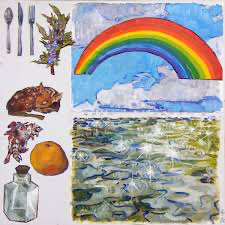
In July of 2025, the band GOON released their third full-length album, Dream 3, continuing to carve out their distinctive sound—a mix of lo-fi punk energy, folk textures, and introspective lyricism. The accompanying album art done by the band’s frontman, Kenny Becker, shows a painted landscape of a glistening sea blanketed with heavy but parting clouds with a bright rainbow cutting through the sky. The music like the scene is serene with moments of beauty and contrast like a rainbow or the sunlight reflecting on the water, yet it’s all just surreal enough to make you think it’s life playing tricks on your mind. Becker’s androgynous vocals drown and fade in and out as if carried by the wind that has parted the clouds of the cover art. The beauty of the parting clouds and calming melodies still hold the weight and turbulent,churned waters of emotion. Wailing winds of guitars and vocals still pierce the seascape on the cover and the music it holds.
Prior to their September 11th show at the Cashbah in San Diego, which will be supported by Draag and Marguerite(Tickets still available, 21+), GOON’s frontman, Kenny Becker, joined Kyler from KCR radio in a Zoom call that quickly turned into a conversation discussing the creative process behind the album, the personal struggles that shaped it, and how creative detachment, musical influences, and the stormy realities of life feed into the music.
Throughout their conversation, Kenny shares insights into his songwriting approach, the influence of visual art on his creative vision, and how grief and heartbreak became unexpected, but powerful catalysts for artistic expression. From painting landscapes to crafting emotionally raw tracks, the discussion reveals how Dream 3 became both a personal artifact and a communal experience.
Kyler: Hey How’s it going? I’m Kyler from KCR. Thank you so much for talking with me today!
Kenny: Hey Kyler! I’m Kenny. Thank you!
Kyler: I actually listened to your new album Dream 3 quite a bit this summer. I was working without much service so I was relying on downloaded music. I got one of the songs on my discover weekly, and downloaded the album before I left so it was definitely on repeat.
It’s awesome.
Kenny: That’s fucking awesome to hear. I don’t know if Tamara mentioned this, but I’m from San Diego, actually, so I’m like, I’ve never… I don’t think we’ve ever been, like, interviewed by a San Diego anything, really.
Kyler: Well, yeah, we’re really glad you’re coming back and thanks for reaching out. I appreciate getting to interview you guys. Yeah, no, I can’t wait for the show, too. (…)
But I was telling my roommate about you guys and I was kind of like trying to describe your sound and I was kind of saying that like it feels like through your projects, there’s definitely a GOON sound per se. And I guess there’s themes and differences from album to album–
Like I’d say the first one’s a little more punky. Then like the second one’s got like a little more like folk elements, and then this one kind of seems like a mix of the two.
When I was describing–I was saying kind of like pinback esque. And then when I was looking back into one of your interviews that you did, you said they were your—Like they were one of your biggest influences. And my roommate took me to the Pinback concert in October of last year, and so I felt like it was kind of like a little, circular moment.
I’ll take him to you guys on the 11th.
Kenny: The One in Del Mar?
Kyler: Yeah, at the sound, yeah, we went to–
Kenny: —Yeah, I was there, dude! I was there! And I went to the LA one too. Okay–
Kyler: –Yeah. It was so cool. Like, and that show was awesome. And yeah, it sounds kind of like a little funky venue, but I liked it.
And I know. It was just really cool seeing them live because, yeah, like,I mean, they are legends.
Kenny: Dude, yes. They were awesome…
Kyler: I’d love to kind of hear you a little bit more about kind of like just musical inspirations and maybe ones that you felt like coming out a little bit more in Dream 3.
Kenny: Dude, yes. Well, Pinback is very a funny one for me because it’s like… I don’t think I can overstate how important they are to me.
I’m almost obsessed with them on a level that… Like, okay, so, for example, there’s a song on Dream 3 called “Closer To.” And that one was like written, recorded, lyrics written, mixed. Like, we went through the whole process and the whole time it was using its working title; “Pinback.” We just called it “Pinback.”
It’s like, this one sort of reminds me of this song “From Nothing to Nowhere,” which is kind of a faster pinback song off of Autumn of the Seraph (Pinback’s 6th album), the opening track, and it’s kind of interesting. Pinback represents so many things to me. Specifically, their playfulness with tempo is really fascinating to me.
Where their songs— The songs that they’re most well known for are these sort of low, quiet, hushed, like chilled out bummer kind of things. And then when you see them live.
It’s like fucking party mode and it’s like everything is like 10 BPM faster and Shit! It can be jarring, but then you sort of surrender yourself to it and you’re like, “This is just a fucking blast!”
And I don’t know– I think Rob Crowe, especially exemplified this, playful prolificness or whatever, and it allows him to like—and Zach does this as well for sure— but I think Rob has encouraged me. I’ve never even met him, but it’s just like becoming basically a student of his work. To follow excitement as a guide in making music and not like, you know what I mean?
He’s just kind of like, oh, he’s tried this. And now he’s going to try it this way. Because we’ve already done it like the flow of this way. I don’t know if this is really making sense. But that was a really, yeah, like a guiding… Yeah principle on this record.
Kyler: Yeah, like, (…) like a guidance point kind of thing. And then like, you know his or like what he picks up is good and then kind of like play within the realm yourself. Is that kind of a fair interpretation?
Kenny: Yeah, like… It’s almost like this feeling of—. For example, because this is our third record—The first one, I feel like, really has this feeling of trying really hard to really do something, I guess. For lack of a better way of saying it.
There’s a lot of naive, optimism and just sort of go for it attitude that I can see looking back at that first record. It’s a clunky, imperfect thing that I’m happy that we did it, learning from those mistakes trying again in the second record, which, yeah, is kind of airy and folkish, more kind of… And like it has more strings and lush vibe is a little bit—it’s not like trying to be a departure. It’s just kind of like, well, we tried that. So now it’s time to try something else.
And then this record, I think is even more in that spirit of like, everything felt almost disposable in the process of making it. Every song was just for fun, kind of. And it was only once it seemed like we were onto something that we would continue finishing songs and and yeah… I don’t think I could have had that sense of freedom on anything but my, like, third album. I don’t make sense Ha Ha….
I had to get a few out of the way and do what I sort of thought I was supposed to do. And then in this sort of paradoxical-ish, maybe not, but like a twist, this ends up being the record that I’m like most proud of and like, I think is our best one by far. But if it felt the most like loose. You know what I mean? Whereas the other ones had more of a tight grip vibe.
Kyler: Yeah,I know. Did you do the– You know, the Reddit interview that you did?
Kenny: Yeah.
Kyler: Was that before that was before your last album, correct?
Kenny: Yeah, it was like right around…it was like, I think it was before the last album. It’s so I can remember if it was before or after it came out.
Kyler: Okay… And I feel like you kind of talk about this in one of your responses, kind of like, you’re talking about how you do your kind of like sound arrangements and kind of having, you’ll start with the guitars and then if like you try to kind of— I forget how you exactly you phrase it, but…
‘Trying to close the gap between finding guitars that you like, and then taking it to the next step of, like, finding guitars that have good songwriting opportunities. And, if lyrics don’t stick right away, you get rid of it.’
I loved that response a lot because it’s kind of like that healthy detachment kind of thing and how connected that is to the creative process.
I would love to, I know you just spoke about that, but kind of I would love to kind of just hear kind of like more about that. How you kind of like, if it was if it was something that you kind of like always knew that you would have to happen?
Or if it was something you found yourself doing more throughout each album?
Do you think this practice and the, like, creative process as a whole helps you deal with other parts of life?
I know, especially with the context of this album and going through a collapsed marriage in the middle of the process. And it’s kind of like letting things go. and I would love to hear kind of like more about that and how that helps you kind of take that next step and allow you to come out with an album that you kind of felt like it was your best?
Kenny: Right. Dude, yes, that’s kind of, actually, like, I don’t know. Weirdly, I don’t know if I’ve ever actually, like, put it together like that, but I do think that is so true.
Because, if you can treat a creative endeavor as disposable, at least for me, that really helps. So if it’s kind of like if you’re already putting pressure from the very beginning of like, ‘I’m about to make my masterpiece.’ Sometimes that is the mentality you need, I think. And I don’t think it’s inherently wrong to feel that way.
But I do think the ability to use the eraser or the delete button as its own, like. color on your palette You know what I mean? Because it’s a creative tool. It can really unlock some shit that you’re like, like, it’s just so freeing to be able to, like, start doing something and then just be like, actually, nah, let’s do another one.
Or like, you know, making art with that mentality, I think, has sort of taught me, is that it’s like…, I am not, genius or whatever. You know what I mean? I don’t think any artist really is.
It’s more, and this sounds like this might be a cliche…Hey! You may have heard this one before. But it’s like… ‘The best artists, I think, are the ones that can make themselves like a conduit for a good idea.’ And artists can snatch them as they float by and then pick them off the ground and pour water on them and nurture them when they are easily trampled upon and killed. You’re the ones tending to it, even when no one else quite gets the vision. And like, you didn’t make that idea or that seed.
I mean, David Lynch said it really good about the thing of like, “There’s a chef that can prepare a fish, like, and make it worth, like a plate that is worth like $200 or something. And then a different chef can prepare that same exact fish, and it can be worth $10… Or it can even be really bad and make you sick because it’s prepared poorly.” BUT the chef didn’t make the fish! You know what I mean?
They were just a steward of this like thing that happened to swim by and could have just kept swimming right by… if they didn’t, like grab it. You know what I mean? Like I’m making this chef be the fisherman, too in this analogy. But you know what I mean?
Kyler: Yeah. I haven’t heard that one. That David Lynch one. But, I’ve heard kind of another one where he’s like talking about ideas and he’s like if you don’t like writing it down and he’s crazy dramatic about it. he’s like, “it’s like you’re fucking committing suicide by not like writing your like ideas down” and but yeah, a little more different, but I love that one a lot… But yeah—
Kenny: —Dude, yeah, for sure. And so I think, like… having gone through what is, like, easily the most heartbreaking, traumatic breakup of my life, let alone, you know, breakup experience of my life. It was just like earth shattering. And I feel like I was completely transformed by this experience and in some ways, I’m still being transformed by it. And going through something like that can…
I think it really made me treat life… Again, not to tip too much into like a cliche… but like sort of this more of a fragile, loose thing that’s just kind of happening Right Now! And might not be happening in a few seconds. So it’s like treating it like this… I don’t know, moving through life and creative endeavors with this reverence, and trying to be sensitive to subtlety.
It’s like, ‘Oh! Changing the melody, that tiny little bit actually makes me think about, like, somehow it gave me that feeling that, I don’t know, this weird childhood memory of some random thing.’
That it’s only because I tweaked that note, and I probably would tweak it back because my fingers slipped. But because I’d noticed that it made me feel that way. Now I think that’s how it should be. You know what I mean? I just feel like that it’s not because I went into it being like, “And now we will make our masterpiece!!”
I was kind of describing it to someone like, ‘It feels… Creativity in this way… It feels more like following this like a magic rabbit, or woodland creature through the twists and turns of some like a dark forest rather than following like a blueprint,’ so to speak. And like, if you come in with these fully formed ideas, not to say you won’t do something cool, but like, I think you’re closing yourself off.
So I guess, it’s just like realizing that my ideas can lead me to places, but sometimes they don’t. And so sometimes they just need throwing away, okay? And then seeing what the next thing is, or like. And using starting over and deleting as a powerful tool, basically.
Or something to react to! That can also be another way to think about it. Like, I often think about it in painting metaphors: sometimes a feeling of you can get so precious as you build up a painting—And it’s not to say this will always help you but it can really change your vibe if you just do something really drastic to it that you can never take back and can’t undo.
It’ll just force you into a state of reacting in real time rather than sitting down and being like, ‘And then I will add this color, and that is why that part of the painting will be good! And then I will add this over here! Nothing wrong with being methodical, but–Yeah, I don’t—Does that make sense?….I don’t know.
Kyler: Yeah, yeah, no, it definitely does. Kind of like, I guess, expectation, kind of limits, perception and kind of moment if you kind of always have like those expectations, kind of dictating it kind of a little bit…
Kenny: Yes. Absolutely.
Kyler: And then would you say, like, when you’re talking about, I know you talk about like kind of like deleting things and then, but then you were also kind of like talking about life letting like the creative process kind of like follow things down like a forested path. When do you know you’re kind of like going too far and like, I don’t know, you gotta hit your like Garmin SOS button or kind of and like cut it and get out of there?
Kenny: Dude, that’s a really, really good question. I often feel, going back to a painting metaphor— A painting teacher that I had one time, He told me that he knows that he’s done with a painting once he feels like it, like, he feels like he’s doing good, good, good, good, good. And then the second he feels like he starts to ruin it, he just sort of stops.
And what you are intentionally abandoning is the potential of fixing that mistake and then actually continuing and to make it even better. But more often than not what he notices every time he tried to fix the mistake and then keep it going, he actually just kept ruining it.
So there’s like, this healthy balance between me and Claire, who was like the producer, engineer, person who mixed it and everything. She and I were able to strike this almost unspoken communication of like, what to keep and what to edit.
A lot of the shit that we kept was super just human. Like, imperfect playing, but it, like, sounded cool. And it sounded even cooler once we ran it through tape, like, five times.
Then it’s like, okay, cool. You could just ask yourself, “Well, should we EQ that a little more?” Or “Should we like, balance that out a little bit?” And it’s like, if you’re asking, “should we?” It almost just feels like you just shouldn’t.
But if your impulse is like, “We definitely need to EQ that.” Or “We definitely need to do this.” Like, if your impulse is screaming at you to do something, then do it. See how it makes you feel. But like… so, in a weird way, it’s like—if I’m asking myself, “Is this done?” then it probably, like, weirdly is, you know?
Kyler: Yeah. I think you also kinda talked about this at one point in one of your other interviews; you were saying you try to keep a level of self control when creating a song. That you try to restrain yourself from putting every cool instrument riff or sound in a song. That there is still a level of complexity from simple arrangements.’
I think personally listening to this last album, and reading that it kinda really clicked. Like, listening to Patsy Twin, throughout the break there’s really only a guitar and a drum. They’re each all over the place, and they bounce off each other. They have this really kind of drastic, but like, dichotomy to them—but they’re alike in their roots. Like, it’s only two things.
It’s very simple and still has this cleanness to it, while kind of having a muddle—slightly overwhelming, kind of just throwing you off a little—but it’s all still very perceptible and perceivable.
I really enjoyed that aspect of your music, and I really liked how it manifested in this last album—or is what I’m trying to say, yeah.
Kenny: Thanks, man. Yeah, that’s amazing. I feel like that is very well said. I personally love, like, complexity in music that is achieved through very simple means.
So it’s like… and I think it’s sort of a way that you can really, like, avoid pretentiousness, you know? If you just kind of, like—you’re not trying to… there’s nothing wrong with, like, going wild with it, but, like, it almost strikes me as a more interesting one.
Yeah, the building blocks are identifiable, but the cumulative effect is both pleasant and sort of disorienting—or at least, like, intriguing in a way that, like, it’s not just simple. It’s, like, a little bit of both. Somehow that makes it even more of both, in a weird way.
Kyler: Yeah, yeah. I also, like—in a lot of the lyrics—I felt there’s a lot of, like, natural aspects. But it’s not always in, like, “ah, oh, nature’s beautiful.” Like, I think in the first verse, in the first song, Begin Here it’s talking about, like, torn ligaments and a creature that is scraped open and doe-eyed, with its soft, terrible noises. And I guess I really, really like that because I feel like there’s both sides to it.
Like, there’s the natural process of things as well. Like, life and nature are not exactly, like, oooh, whimsy and fairies-type things. I love that kind of, like, just reality in nature that’s kind of like—it’s not good or bad or something to be judged. It just happens. And sometimes we want to call it ugly, gross, or sacred and miraculous. But it’s just something that happens.
Yeah. But I really love that theme in the lyrics throughout the album. And I guess—what, like, where do those, like, where does that kind of imagery come from? And as someone who feels there’s a connection between nature and creativeness, what are your thoughts on that?
Kenny: Dude, absolutely. I think there really is… I, like, I feel like one of my biggest sort of, like, creative awakenings as an artist occurred as a painter, actually, when I started taking Glennaire landscape painting classes and, like, painting outside.
It forces you to think of, like… and it’s especially once you have the revelation of, like, anything that I’m looking at at any moment could be a painting. And, like, you can consider shapes and forms of buildings against mountains with trees and power lines as, like, interesting shapes that sort of overlap. And what happens if I make this one a little bigger, or, like, make this one, you know, flatter or farther away against this other one? Or—and then, what if I bring in a living creature?
Like, what does that do psychologically to this piece? And, like, thinking of things that’s almost symbolic, like—I don’t know—representations of themselves and what that would mean? And I found that really interesting. And in the case of this record, there did happen to be the kind of timeline aspect of, like, it began as this truly just beautiful, kind of loose, creative endeavor attempting to make our third record.
We began, like—I don’t even know—like, at least half the songs. But lyrics always come really last for me. So a lot of them would have melodies with no words, but the recordings were well underway. And then that whole, you know, crazy breakup happened. I was just in so much pain.
Going back to that, like, like, just—I don’t know—I enjoy writing lyrics in a way that is just, like, similar to the painting thing I said, and almost similar to the way the album art ended up, which is a bunch of smaller paintings arranged on a bigger painting, like a cut-out of their original canvas, and sort of made into these weird, like, stickers.
The question is just, like, what happens when you put these two shapes next to each other? Like, what happens when I don’t outright say that I’m the most heartbroken I’ve ever been?
Instead, just talk about some maimed animals that are, like, slowly dying at the bottom of the canyon or something. I don’t know, I just sort of made myself feel like Cormac McCarthy a little bit, in a fun way. And then that was just sort of fun to play into, almost, and just explore, kind of—I guess the same thing I was saying about trying to make it more of an intuitive thing.
It’s like, I have these constraints. I know that I need it to be, you know… maybe one line needs to be eight syllables and end with a certain “ah ah” sound so that it can rhyme or not rhyme, or whatever. But, like, I have eight syllables to get there, so, like, within those constraints, I just fill pages, just trying to get, like, one line. Really, the ones that win are the ones that just seem like they mean something.
They don’t always feel apparent to me. It’s just kind of, like, you sort of know it when you see it type thing. So I guess I both know why I like nature imagery, and I also kind of don’t know why. I just sort of like it, you know? Like, I end up using it and… yeah. I don’t know.
Kyler: Yeah, I was going to ask you about the album art. I know you do the album art, and I really liked the connection between the visual art and music—intentional or not. I feel like it’s a really cool consistency you don’t get with most projects.
I love how the art turned out and how it fits the album.
And I guess, kind of circling back, having such drastic and dramatic personal events occur in the middle of creating an album… I know you had some work already done and intentions with that.
What part of, like, the composition happened on either side of your breakup?
Was it mostly the lyrics that changed? Did you go back and change stuff you already had, or just add new elements, or simply change your relation to it?
If that makes sense.
Kenny:, I think… well, For Cutting the Grass, Closer To, Begin Here, Jaw, (the very last song), off the top of my head, those ones for sure were almost finished, except for the lyrics when the breakup began. Some of the lyrics had been written—For Cutting the Grass and Closer To—and recorded. So it’s not to say that no lyrics had been recorded yet.
Closer To was an interesting one. Because, like… literally, this one was way before any semblance of a breakup was going on. I had a couple of lines of lyrics already, and they were sort of describing this… I don’t know. It’s almost like instructional lyrics: “close your eyes, form a vowel, and then bite.”
It’s like… what does that mean? I don’t know. But it’s kind of instructional. And then it goes through this whole cloudy, murky, buildup-loud part, and then it comes back to the verse again. And this next one is a big one—like, “close your eyes, almost brace yourself,” you know what I mean?
I remember thinking—and I think this might even be in our press release or something—I just loved this so much. I remember thinking this would sound like something cool to have as a lyric. I don’t know why, but it seems like maybe someone, somewhere might hear it and find some encouragement or something comforting in it. And in fact, I was the one who did not know that this next one was the big one. And sure enough, it was months away. So that shit was crazy…
I’ll give you a little tidbit—I don’t think I’ve told this. Dude, I fucking wrote “Apple Patch” in the epicenter of my grief, and recorded the whole thing. That was one I played everything on. I went to the studio that day with Claire, and she said… I was blind with grief at that point, and I was just like… I don’t know.
I wrote Apple Patch because my ex and I had a formative, early romantic moment at an Apple orchard. It was a really beautiful time, and I was kind of calling back to that. Sort of in a feeble way, trying to remind her why she might still love me if I could make something so beautiful—a short little song.
But when I first made it, there were no lyrics at all. It was just an instrumental, and I thought it was kind of pretty, but I didn’t even have a singing melody yet. I just called it Apple Patch, and then the pain and heartbreak set in even deeper. That’s when I wrote the lyrics.
So what started as this attempt to express love—or basically “don’t leave me”—became musically… exactly the same. I came up with lyrics that are honestly pretty fucking emo, hahaha. “I lay awakened under the knife, and like, a better home way off in the sky. I’m gonna fucking blow my brains out. I am the twitching guts of a fly.” Right. That one… yeah.
But in a way, I really love that song for what it represents now. It is fully an artifact from this crazy mental state I was in. Yeah. Anyways… yeah.
Kyler: I really like that because it was, like, an artifact when it was just an instrumental, and then you kind of went through grief in the process of it.
And then you made it, like, a kind of monument in time of your processing of something in the past.
So, I really… that’s a really cool story. But yeah, no, I always like the emo stuff too. I wanted to kind of touch on how the process was—like, creating with people in the midst of grief…
And I guess, like, how the moments of creating in isolation, and then creating in a more collaborative setting… how that kind of social interaction worked in the midst—and in the context—of having such a personal experience and trying to express it through a musical and creative process.
Kenny: Totally. Well, when I come confined is the song “Death Spells” that we released as a single in December 2024. At that point, we were well underway with this record, but I had been suffering through many, like, kind of depressive fucking episodes, and it was sort of putting the record on hold a little bit. And then… I sort of was having a hard time, yeah, working on the record in that state.
So I wrote that song, “Death Spells,” kind of in the midst of that autumn 2024, practicing everything and still very much in pain.
I decided, like, let’s put the album on pause for basically a month and just have all the bandmates come in. Because the LP was much more of a hodgepodge—I ended up playing a lot of stuff and would bring the bandmates in as needed—but then there were some songs that were, like, true band songs. Whereas “Death Spells,” I was like, let’s just do this one for real, band-style.
I didn’t want to only play my part and sing on it. I wanted to bring everyone else in. And making this very grieving song with friends was a super beautiful, healing experience.
Because, yeah, I really think the worst part of grief, weirdly, is the loneliness. You sort of feel like you’re the only one who feels this way or has ever felt this way, and there’s no… like, you would only ever be a burden to anyone if you even attempted to explain how you’re feeling.
But as you and I both know, music and art in general, in any form, is almost essentially made for those kinds of times, haha.
It’s like… totally within range to do that. It’s not weird to call up buddies and be like, “Hey, let’s do this song. I’m so heartbroken,” even though I didn’t really even say that. It was just, like, known, you know, haha.
But, yeah. And I think, to the degree that you can feel not alone… you don’t even need to have an answer. Or you don’t really need someone to tell you that it’s going to get better or that it’s going to be okay. Because you already kind of know it—or if it is, it won’t be for a while.
But there’s just something about saying words to another person, or just being with another person. Nothing needs to get said, no fucking heavenly advice needs to be bestowed for it to be therapeutic. Just talk… or don’t talk. Just be with people. Yeah. I found that to be true very much.
And music—this record—was definitely a conduit for that. Yeah, I don’t know..
Kyler: Yeah, no, yeah. I know you talked about, like, one time, being personally drawn—and I forget if it was someone describing your music in their interpretation of it, or you describing your own music—but, like, happy and sad being some of your favorite music.
I feel the same. I’m always drawn to that. And it’s, like, yeah, it’s definitely the honesty and experience behind the creative process and the music.
As much as I like happy music—at times I can’t listen to Party in the USA 24/7, I guess Hungover in the USA, you know?—I loved your album and its honesty.
And I know we are getting close to time, so thank you again for chatting
Kenny: Thank you!